
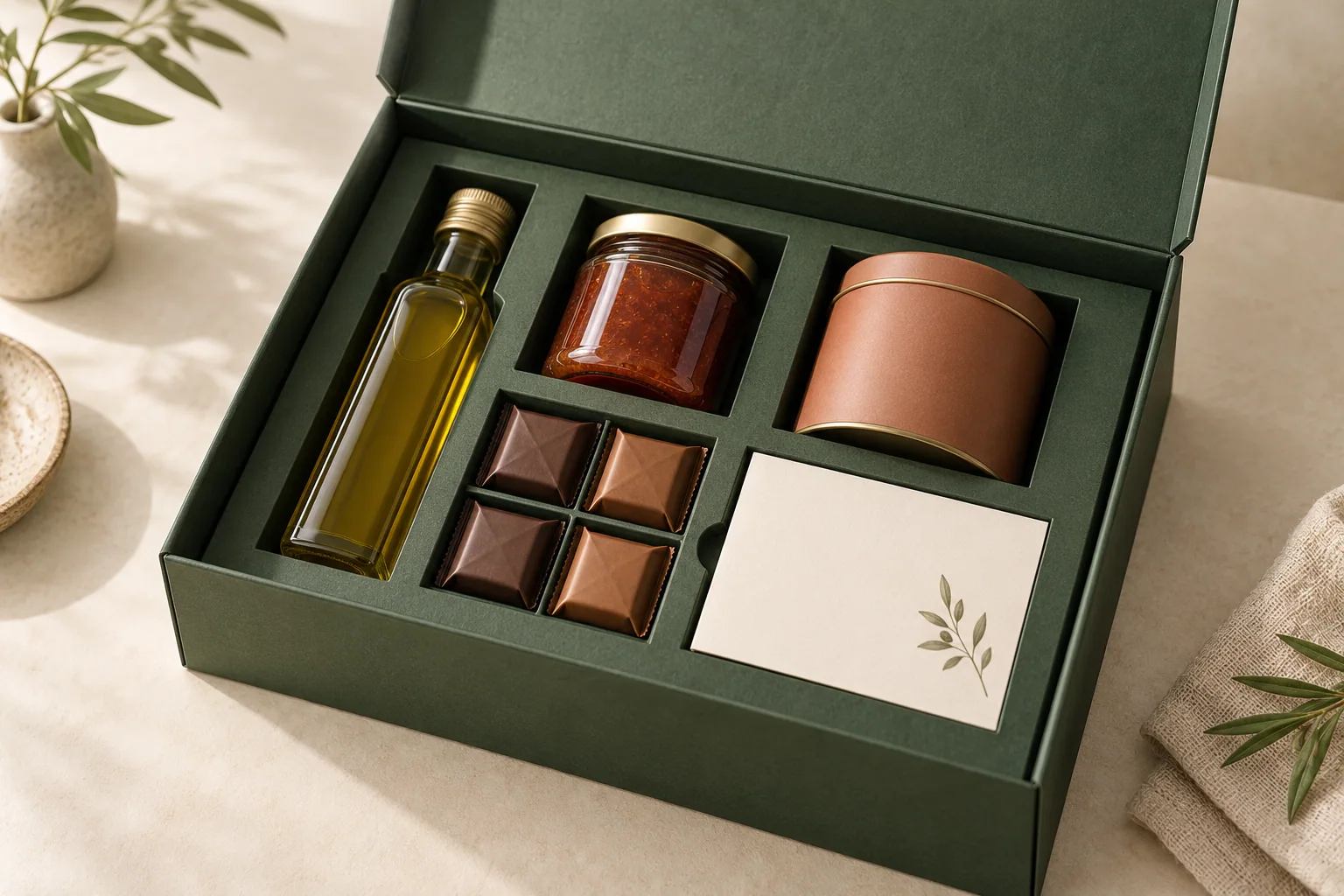
Food gift box packaging has to do several jobs at once. A box of chocolates may need orderly presentation and easy access. A gourmet hamper may combine bottles, jars, tins and smaller packets with very different shapes. The outer package must make the selection feel like one gift, while the interior should keep each item in its intended position.
This guide is for food brands, specialty retailers, gourmet producers, gift companies and packaging buyers planning custom food gift boxes. It focuses on practical decisions: which structure to evaluate, how to plan the insert, what to confirm about food-contact materials and how to prepare a supplier-ready brief.
Why food gift packaging is a timely category
Seasonal occasions bring food, hosting and gift presentation together, but market signals need to be interpreted carefully. The National Retail Federation’s October 2026 forecast projects U.S. November–December retail sales to grow 4.2% year over year. That is a forecast for core retail overall—not a forecast for food gifts or packaging specifically. It does, however, give brands a reason to prepare holiday and year-end assortments with clear value and sound execution. Read the NRF 2026 holiday sales forecast.
JLL’s 2026 holiday shopping survey offers a more category-specific signal: respondents planned a larger share of seasonal spending for food and decorations, while gift budgets grew more modestly. This suggests that food is an important part of the holiday occasion, though it should not be presented as proof that every consumer is buying a packaged food gift set. For packaging teams, the useful takeaway is to design for both the product and the moment in which it will be shared. See JLL’s 2026 holiday shopping report.
Packaging also contributes to how a seasonal item is perceived. Innova Market Insights reports that more than three in four consumers globally regard seasonal wrapping as important, while its research highlights quality and practicality—such as maintaining freshness and being easy to open and close—as expectations for occasion packaging. These are useful design prompts, not a guarantee that a particular color, finish or box style will sell better. Read Innova’s special occasions packaging overview.
Start by mapping the products in the gift set
Before selecting a box, prepare a simple product map. Record the items included in each version, their finished retail-pack dimensions, weight, orientation and any fragile or pressure-sensitive areas. Include caps, lids, seals, sleeves and protective wraps in the measurements. A small bottle measured without its cap or a chocolate carton measured before its sleeve can create a poor fit later.
Then decide how a recipient should see and remove the assortment. Should the largest product be centered? Should a note sit above the contents? Should each item lift out individually, or should the inner tray come out as one piece? A top-down layout drawing—even a clear annotated photo—helps the packaging team discuss the arrangement before a die line or sample is made.
- List every SKU and the number of units in one gift set.
- Record packed dimensions, weight and the preferred orientation for each item.
- Mark glass, sharp edges, fragile closures, leak-sensitive products or surfaces that can scuff.
- Identify which items are already sealed in their own primary packaging.
- Sketch the desired reveal order, card placement and any removable tray.
This product-first approach often saves time because it can reveal conflicts early: two tall jars may not fit beneath a shallow lid; a heavy bottle may need a more substantial support zone; or the insert might leave no room for the card that gives the gift its context.
Compare box formats by presentation and route
No single structure is right for every food gift set packaging project. Compare the finished box against the complete use case—retail shelf, hand-delivered gift, corporate distribution or parcel shipment—rather than choosing by appearance alone.
Folding carton
Consider for lighter, pre-packed assortments where flat storage, efficient assembly or a clear retail display matters. Check board stiffness, closure security and whether the package needs a separate display or transit component.
Rigid lid-and-base box
A rigid box can create a substantial presentation for chocolates, tea, coffee or a curated gourmet selection. Assess the extra packed weight, storage volume, assembly steps and insert cost along with the premium appearance.
Magnetic or book-style box
Use this format when the opening sequence is part of the gifting experience. The flap, closure, insert and products need to work together; confirm that the lid closes without pressing on jars, bottle tops or tall items.
Mailer plus presentation pack
A mailer can help with shipping and fulfillment, but a decorative inner gift box and an outer shipping carton may have different jobs. Test the entire packed configuration rather than expecting a presentation box alone to absorb every transit impact.
For a simpler two-piece construction, compare custom lid-and-base boxes; for a heavier presentation, review rigid gift box formats. The best choice still depends on product weight, quantity, storage and route. A supplier should be able to explain the trade-offs instead of treating one format as universally superior.
Design the insert for the actual pack-out
The insert is the part of a gourmet gift box that turns a collection of separate products into an organized set. It can separate items, reduce unwanted movement inside the presentation box and guide the opening experience. But a cavity that looks good in a drawing may be difficult to load, may grip the item too tightly or may leave the product vulnerable during distribution. That is why gift box inserts for food should be developed and checked with the actual packaged products whenever possible.
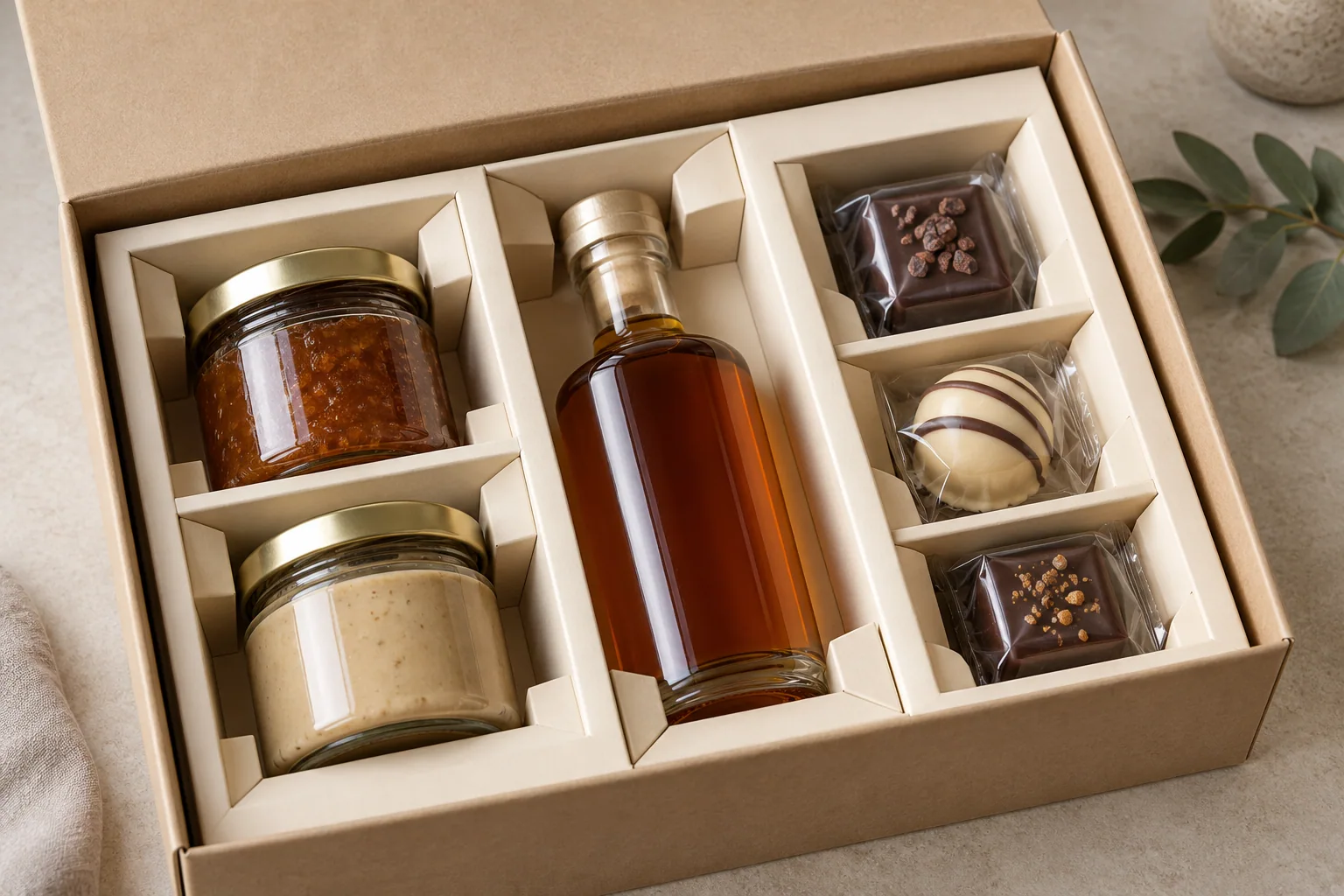
For a set containing a bottle and several jars, a long channel can orient the bottle while individual cavities keep jars from colliding. Smaller chocolates or sachets may fit in a separate tray or under a card. For a uniform chocolate assortment, a grid insert can make the count and arrangement clear; the internal liner or direct-contact component must still be separately specified for its intended use.
When planning the insert, check four things together:
- Retention: Will the item remain in place when the closed box is gently tilted and handled?
- Separation: Are glass, metal, tins and rigid cartons kept from rubbing or knocking against one another?
- Removal: Can a recipient lift each item without tearing the insert or needing to pull hard on a fragile cap?
- Pack speed: Can a packing operator load the items in a repeatable order without forcing components into position?
A paperboard insert can be a good candidate when the set needs organized presentation and the packaging specification calls for a paper-based construction. Other materials may be evaluated for a specific product or route. Compare real samples, intended use, material documentation and total pack performance instead of assuming that one insert material will suit every food product.
For more detailed cavity and removal planning, use the site’s custom packaging inserts guide. If the products are not yet measured, start with the box measurement guide and record internal dimensions separately from external dimensions.
Separate the decorative gift box from food-contact packaging
This distinction matters. A decorative outer gift box may hold individually sealed products without ever touching the food. A tray, liner, coating or inner wrap might be closer to the product—or might directly contact it. Do not call a box or insert “food-safe” based only on its appearance, paper content or the fact that the food is packaged inside it.
In the United States, FDA explains that food-contact substances can include packaging components and substances applied to packaging surfaces, such as certain adhesives and colorants. Its guidance for determining the regulatory status of food-contact material components also directs users to evaluate the applicable component rules, including provisions for paper and paperboard. The relevant review depends on the material, intended use, product, conditions and market. FDA: Food Packaging and Other Substances That Come into Contact with Food; FDA: Determining the Regulatory Status of Components of a Food Contact Material.
For a packaging brief, make the contact boundary explicit: which components are decorative secondary packaging, which components touch a sealed retail pack, and whether any component is intended to contact food directly. Ask the material supplier and the food brand’s qualified compliance contact what technical documents or market-specific checks are required. Keep the answer tied to the intended application; a material statement for one use or market does not automatically establish suitability for another.
This article is a design and procurement guide, not legal advice or a food-safety certification. Leo Paper Box can help specify the paper box structure and discuss packaging components, but the brand or responsible food-business operator must confirm its own product and regulatory requirements.
Make premium presentation practical
Premium gourmet gift box packaging does not require every finish at once. Start with a clear visual hierarchy: one focal brand element, a deliberate palette and enough contrast for the product assortment to read quickly. A restrained paper texture, precise color, foil detail or small printed story card can support a premium impression when it fits the brand and budget.
Innova’s special occasions research notes the value consumers place on novelty and premium design, but it also highlights quality and practicality. For a real packaging project, translate that into checks a team can control: Is the product arrangement easy to understand? Does the lid open cleanly? Is the card easy to find? Can the box be closed again? Is the outside large enough to feel gift-ready without leaving unnecessary empty space around a compact set?
For chocolate gift box packaging, interior order and piece protection may matter more than a complex exterior mechanism. For bottles or jars, the insert and lid clearance may deserve more attention than an extra finish. For a mixed tea-and-snack set, a simple sleeve or printed insert card may be enough to explain the assortment. Choose finishes after the structure and product layout are stable, so artwork is not approved against dimensions that later change.
Plan for storage, shipping and seasonal repeat orders
A gift-ready box and a ship-ready box are not automatically the same thing. Retail programs may optimize shelf display and hand carry. Corporate gifting may require multiple destinations and a fixed event date. E-commerce may add parcel handling, master cartons and warehouse storage. Share the actual route with the packaging supplier before approving the sample.
For direct-to-consumer food hamper packaging, record the packed weight and dimensions of the gift set and any outer carton. Check whether the insert retains items in the orientation used for packing and whether the shipping carton provides appropriate separation and cushioning for the route. A photo of an attractive gift box is not a transit test. Depending on the product and shipping plan, the team may need a relevant package test, carrier guidance or a qualified laboratory assessment.
Also account for temperature, moisture and freshness requirements at the product-packaging level. A decorative paper gift box does not provide temperature control or replace a primary package designed for freshness. For sensitive products, the food brand should define the product’s storage and handling needs and make sure the complete packaging system and fulfillment plan support them.
If you expect seasonal artwork or a repeat order, keep the structural specification separate from the changing decoration. Preserve the approved dimensions, board, insert drawing, artwork files, color references, packing order and master-carton plan. That gives the next edition a stable starting point while allowing a sleeve, card or printed surface to change.
When the gift set will ship to individual recipients, compare the presentation pack with the broader e-commerce packaging design checklist. If cost is still being evaluated, see what affects the cost of a custom gift box and prepare a realistic quantity range before requesting a quote.
A supplier-ready checklist for custom food gift boxes
A packaging supplier can make a more useful recommendation when the brief describes the full job. Before requesting a sample or quote, collect the following:
- Product list: SKU names or descriptions, unit count and final primary-package dimensions.
- Weight and orientation: packed weight for each item, the full set and any fragile or leak-sensitive areas.
- Market and contact: countries of sale, food-contact boundary and any supplier documentation the compliance team needs to review.
- Channel: retail display, gift handoff, corporate distribution or direct shipping.
- Structure: preferred format, opening sequence, insert, divider, card and any window requirement.
- Branding: logo files, artwork status, color references and the finishes that matter most.
- Commercial plan: sample quantity, pilot volume, target order range, delivery destinations and required in-hand date.
- Validation: real product samples or accurate dummies for fit, closure, pack-out and route testing.
Ask the supplier to state the assumptions behind the first proposal. If a quote assumes a certain insert material, product orientation, direct-contact boundary or shipping arrangement, document it before the sample is approved. That is more useful than comparing two prices that were calculated from different assumptions.
Leo Paper Box develops custom paper packaging for food, chocolate and premium gifting projects. You can explore the food and chocolate packaging page, compare lid-and-base or rigid gift box formats, then send a packaging brief with the product dimensions, set layout, quantity and destination market.
Frequently asked questions
What is the best packaging for a food gift set?
The best food gift set packaging depends on the contents, weight, sales channel and presentation target. A folding carton can suit some lighter retail assortments, while a rigid gift box can support a more substantial presentation. Bottles, jars and mixed products usually need a fitted insert or divider, and direct-to-consumer orders may need a separate shipping carton.
Can food touch the inside of a decorative gift box?
Do not assume that a decorative paper gift box or insert is suitable for direct food contact. If food will touch a packaging component, confirm that component's intended-use suitability and documentation for the destination market with the food brand's compliance team and material supplier.
How do I stop bottles and jars moving inside a gift box?
Measure the finished retail containers, including caps and any protective wrap, then design separate cavities or dividers around their shape and orientation. Test a packed sample for movement, contact between glass items, closing pressure and removal. A fitted insert is only one part of a complete shipping-protection plan.
Is a rigid box or folding carton better for gourmet gifts?
Neither is universally better. Compare presentation, packed weight, storage, assembly, quantity, shipping route and total cost. A rigid box may suit a premium handoff; a folding carton may be easier to store flat before assembly. Make the choice with a physical sample and the actual product set.
What details should I send for a custom food gift box quote?
Send the product list, each packaged item's dimensions and weight, a layout or photos, the target quantity, sales channel, destination market, artwork status, preferred box format, insert needs and delivery date. Identify which products are already sealed in primary packaging.
Research and references
- National Retail Federation, “NRF Forecasts 2026 Holiday Sales Growth as Consumers Remain Resilient” (October 15, 2026) — U.S. November–December retail forecast; not a forecast of food gift packaging demand.
- JLL, “Holiday shopping 2026: bigger budgets, fewer names” — survey context on planned holiday budgets, food and decorations, and gift spending.
- Innova Market Insights, “Special Occasions Packaging Trends: Global Overview 2026” (June 1, 2026) — consumer perspectives on seasonal packaging, premium presentation and practicality.
- U.S. Food and Drug Administration, “Food Packaging & Other Substances that Come in Contact with Food” — official overview of food-contact substances and packaging components.
- U.S. Food and Drug Administration, “Determining the Regulatory Status of Components of a Food Contact Material” — official information for checking material components and applicable food-contact rules.
Editorial note: Market research and regulatory links are included as external references, not as claims that one structure or material will suit all products. Confirm product-specific packaging and food-contact requirements with the responsible brand, material suppliers and qualified advisers for each target market.