
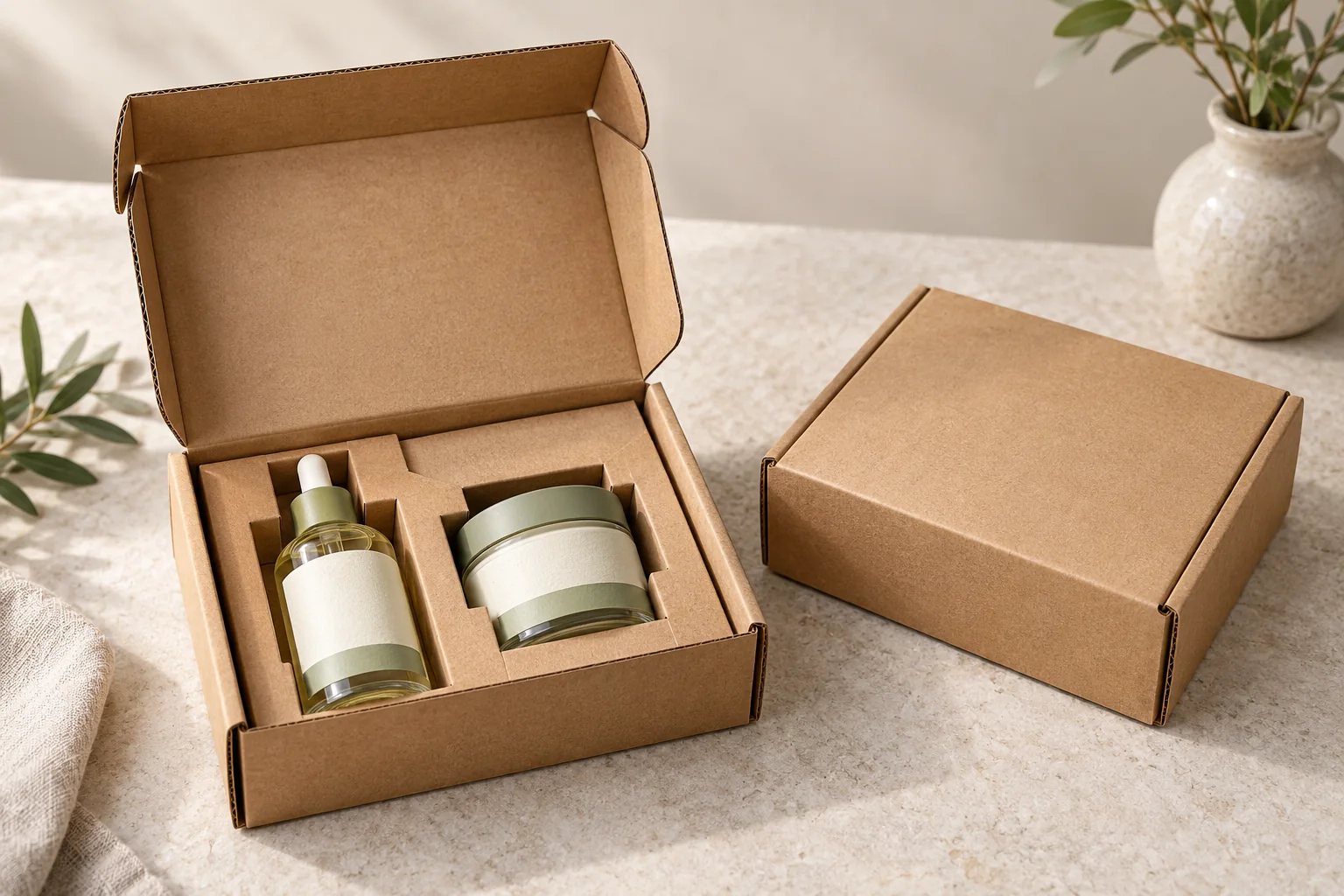
Good e-commerce packaging solves more than one problem.
An e-commerce package has to protect a product through sorting, handling and last-mile delivery, while keeping the parcel practical to pack and pleasant to open. A smaller box is not automatically a better box: if it causes product damage, returns or replacement shipments, the apparent material savings may disappear.
A useful way to evaluate e-commerce packaging design is to compare the total delivery system: package materials, billed shipping dimensions, packing labor, product damage and the customer experience. Deloitte’s 2026 delivery packaging study describes these same connected roles—protection, brand experience, efficiency and sustainability—in its e-commerce packaging research.
1. Start with the delivery route, not the box style
Before comparing custom mailer boxes, write down how the product will actually travel. A parcel delivered directly to a consumer may face repeated handling and uncontrolled orientation. A product packed into a larger master carton follows a different journey. A retail-ready gift box may need a separate outer shipper for parcel delivery.
Soft, non-fragile products
Apparel, soft goods and some flat items may work in a compact mailer or carton. Check corner crushing, moisture exposure, label space and whether the product can crease or scuff.
Glass, ceramics & beauty
Use a mailer or shipper with a support system that keeps the product from striking the walls. Separate fragile components and assess the cap, pump, edges or finish—not only the container.
Kits & mixed assortments
Give each item a defined position so products cannot collide or migrate. Check that the insert still works when the assortment changes and that the pack order is easy to repeat.
These are starting points, not performance guarantees. For example, a rigid presentation box can elevate an unboxing, but it may not be a shipping carton. Compare a custom mailer box or custom shipping box with the product’s weight, handling and route.
2. Design around the packed product
Measure the complete contents, including accessories, caps, protective sleeves and any card or sample that ships with the order. Then decide the product’s orientation and the clearance needed to load and remove it. Record internal cavity dimensions separately from outside dimensions; our guide to measuring a box covers the measurement conventions in more detail.
- List every item in the order and its packed weight.
- Mark fragile edges, surfaces that scratch, leak risks and parts that can loosen.
- Choose a stable orientation and check how the product sits after the mailer closes.
- Leave room for the insert and loading—not arbitrary empty space.
- Check the final external dimensions and weight with the shipping label in place.
Do not force a tight fit around a tolerance-sensitive product. A practical sample should be easy for an operator to pack consistently and should close without bowing, pinching the contents or putting pressure on a fragile component.
3. Use inserts to control movement, not just to decorate
A well-designed protective packaging insert limits movement and spreads contact where the product can tolerate it. Folded paperboard can organize lighter products or multi-item sets. Corrugated supports can add structure where a heavier item needs a load path. The right construction depends on product mass, shape, fragility, package size and the distribution route.
Check three things in a physical sample: the product cannot build up momentum inside the box; the insert does not create a damaging pressure point; and the insert stays in position after the package is turned and handled. Also time the pack-out. A clever insert that takes too long to assemble may be a poor fit for a high-volume fulfillment line.
Paper-based materials are not an automatic substitute for every protective format. Amazon’s September 2026 account of a new extensible paper packaging program describes material engineering and performance testing for a specific use case. It is a useful example of validation—not evidence that any paper mailer can replace any plastic format. See Amazon’s report on its paper packaging development.
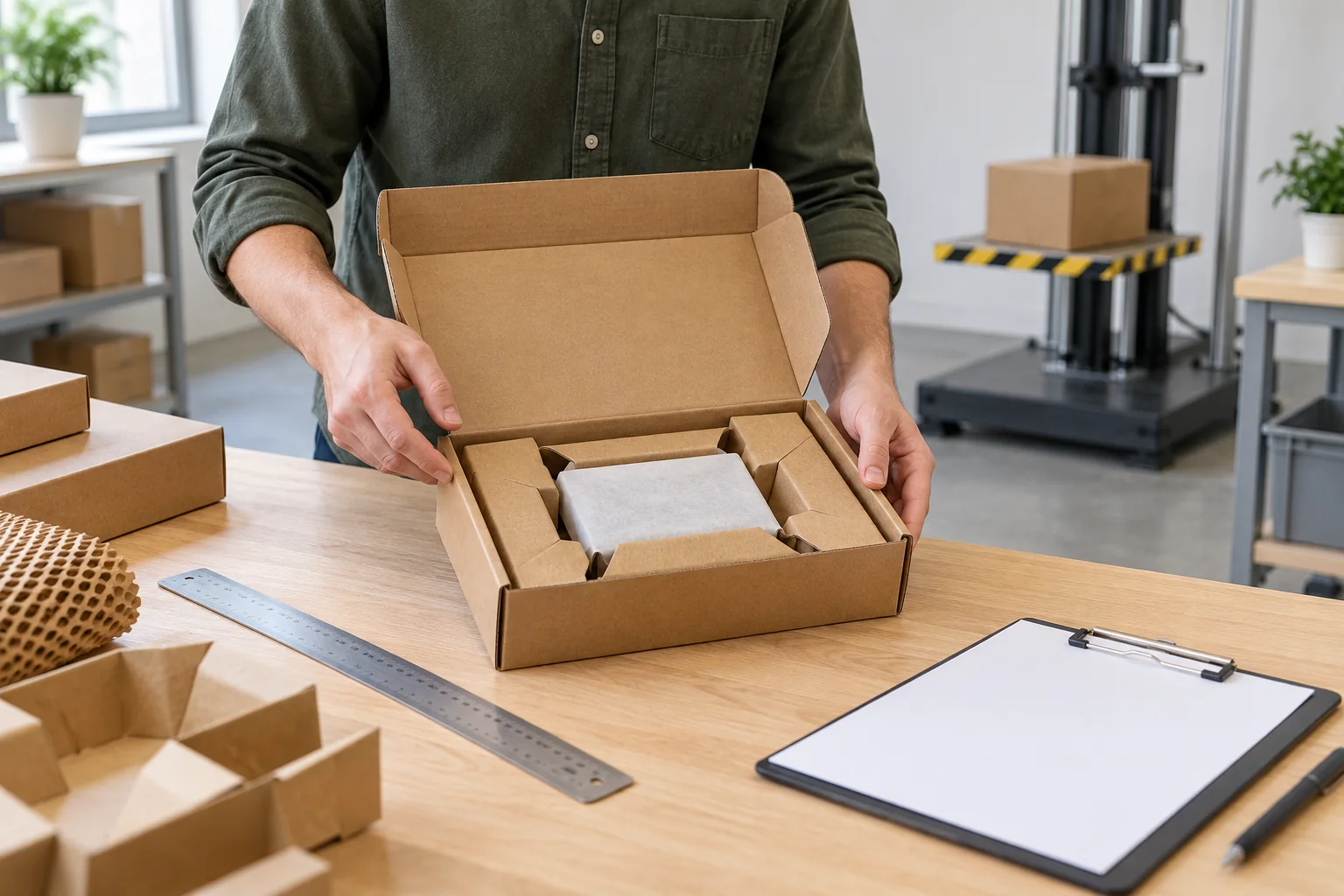
4. Right-size packaging with a controlled comparison
Right-sizing means removing avoidable volume while preserving protection and a workable packing sequence. Compare two or three samples using the same product, insert, closure and shipping method. Record the external dimensions, packed weight, amount of filler, pack time and what happens to the product after the chosen handling test.
Ask your carrier or logistics provider how the actual service calculates charges for the package. Dimensional-weight rules, thresholds and billing details vary by carrier, service and destination, so do not rely on a generic online example when pricing a live order. A slightly larger package that reduces breakage may be less expensive overall than a smaller one that increases damage and replacement shipping.
For brands selling into the EU, packaging minimization is also a regulatory topic. The European Commission says the PPWR began applying in phases on 12 August 2026, while measures including new limits on empty space are scheduled from 2030. Check the applicable timeline and guidance for your packaging rather than treating a future requirement as already in force. Our separate PPWR packaging checklist covers the broader compliance questions.
5. Test a production-representative sample
A convincing studio photo cannot tell you whether a package will survive the route. Test the product inside the final or production-representative outer package, with the real insert, closure, tape, labels and packing sequence. Photograph the sample before testing and inspect both the product and package afterward.
Depending on the shipment, a test plan may consider shock or drops, vibration, compression, orientation, temperature or humidity. Use a procedure selected for the product and distribution channel. The International Safe Transit Association’s procedure directory distinguishes tests by shipment type; it lists Procedure 3A for parcel delivery system shipments and Project 3L for generalized e-commerce retailer fulfillment. Confirm the current procedure and scope with a qualified packaging lab before claiming a package meets a standard.
After each test, look for product movement, cracks, leaks, scuffing, crushed corners, torn seams, insert collapse, closure failure and unreadable labels. If a sample fails, change one design variable at a time—such as insert geometry, board grade, clearance or closure—then repeat the relevant review. This makes the next iteration useful rather than guesswork.
6. Make the customer experience and fulfillment work together
The delivery package is both a protective layer and a brand touchpoint. Keep print and messaging where they help the recipient recognize the brand or understand the contents, but avoid adding components that slow packing or complicate sorting. Test opening with the same care as closing: an insert should present the product clearly without making removal awkward.
For recurring orders, document the exact component sequence and assembly steps. If your program is subscription-based, see our separate guide to subscription box packaging; this article focuses on shipping performance and package validation across e-commerce orders generally.
Packaging brief: what to send your supplier
Copy this short brief into your request for a sample or quote:
- Product name, packed dimensions, weight and fragile parts
- Order contents, including accessories, cards and promotional items
- Shipping route, carrier/service if known, and whether the box ships alone or in an outer carton
- Expected order volume, pack-out method and storage constraints
- Desired materials, print requirements and any recycling or market requirements
- Known damage, returns or handling issues with the current package
- Sample deadline, launch date and the test or approval criteria
How Leo Paper Box can help
Leo Paper Box develops custom paper packaging including mailers, shipping boxes, rigid boxes and fitted inserts. Share the product, route and packing constraints so the structure can be reviewed as a complete pack-out rather than selected by appearance alone.
Explore our custom packaging capabilities and factory and quality process. For a project comparison, send your dimensions, quantity, artwork, destination and sample timeline through the quote request page. If sustainability is part of the brief, our guide to sustainable luxury packaging explains why the whole material system—not just the outer box—needs to be considered.
Sources and further reading
- Amazon, “Meet the new paper replacing Amazon’s plastic packaging” (September 9, 2026) — a case study of material development and packaging performance tests.
- Deloitte, “Omnichannel delivery packaging study” (May 6, 2026) — delivery packaging, brand, efficiency and sustainability.
- ISTA, Test Procedures — choose a test procedure by package and distribution system.
- ISTA, Project 3L — generalized e-commerce retailer fulfillment test overview.
- European Commission, “New EU rules on packaging enter into application” (August 11, 2026) — phased PPWR application and later waste-prevention measures.
Note: This article is general packaging education, not carrier approval, ISTA certification, legal advice or a guarantee against transit damage. Confirm the applicable test procedure, carrier rules and market requirements for your product and route.