
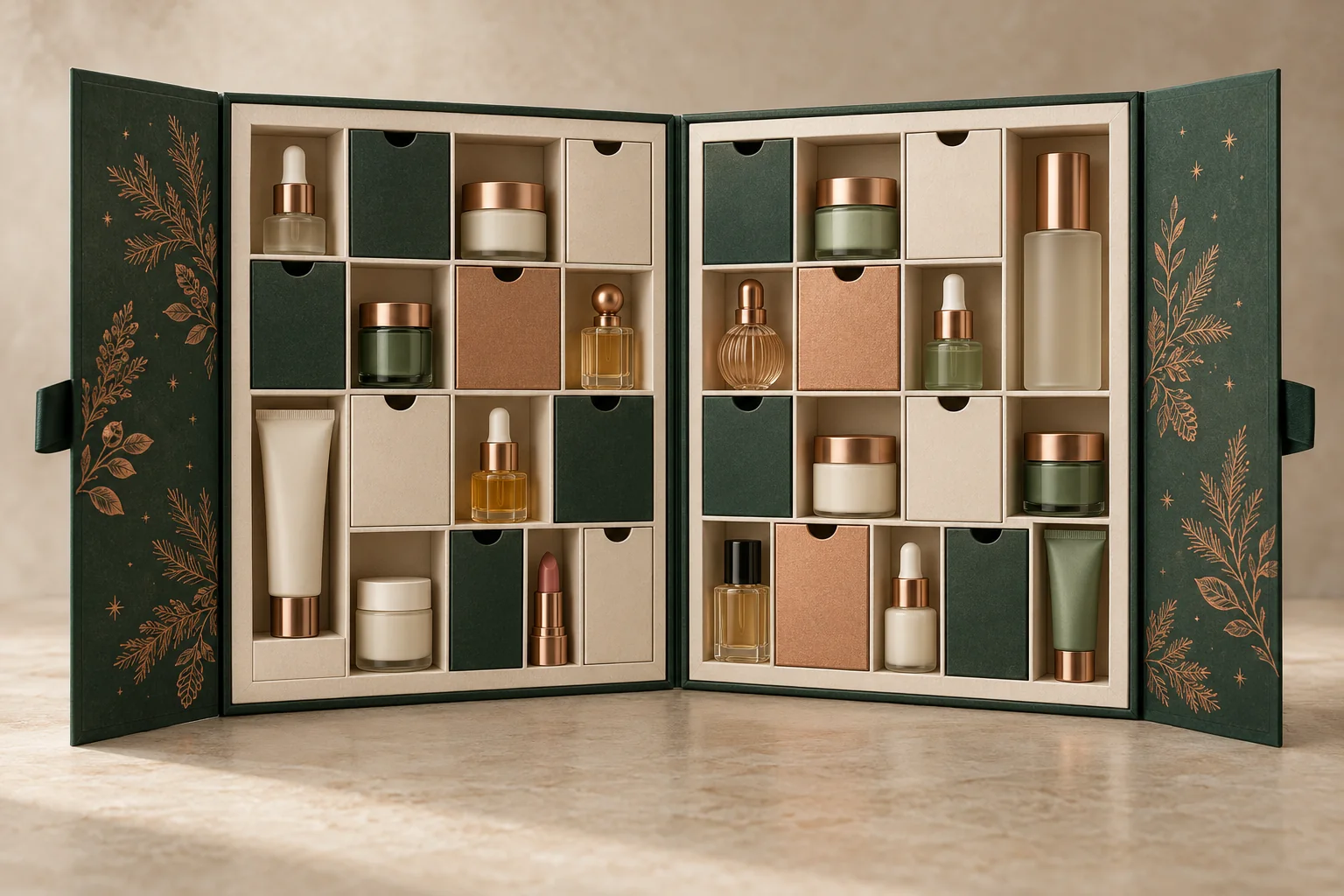
Beauty Advent calendar packaging starts with the products—not the door count.
A custom beauty Advent calendar has to do several jobs at once: organize a daily reveal, protect a mixed product assortment, communicate the brand, and arrive in a condition that feels gift-worthy. A handsome outer box is only one part of the system. The product list, internal compartments, loading order, closure and shipping plan all affect the final design.
That complexity is visible in current retail assortments. Vogue’s 2026 beauty calendar roundup includes sets spanning skincare, makeup, hair care and fragrance; its Selfridges example contains 40 products, including 33 full-size items. That is a retail example, not a universal specification, but it shows why a calendar’s inner layout should be designed around the actual SKU mix rather than a repeated row of identical cavities. Read Vogue’s 2026 beauty Advent calendar roundup.
1. Build a product map before choosing the format
Ask merchandising or product teams for the finished assortment—not just a list of product names. A “mini serum” and a “mini cream” can occupy very different space once the bottle, cap, carton and any protective sleeve are included. This inventory becomes the foundation for a reliable beauty Advent calendar box.
- SKU name, quantity, packed length × width × height and packed weight
- Container type: glass dropper, pump, tube, jar, lipstick, fragrance vial or sachet
- Fragile features, sharp edges, leakage concerns, cap movement or surfaces that scuff
- Which items should be full-size, sample-size or grouped together
- Preferred order of reveal and any products that need a specific upright orientation
- Retail display footprint, outer shipping carton and fulfillment method
Next, arrange the products on a simple plan view or a digital dieline. Mark each compartment’s internal dimensions separately from the outside dimensions of the package. Our guide to measuring box dimensions explains the distinction and helps keep a supplier brief unambiguous.
2. Compare 12-day and 24-day layouts against the real brief
A 12-day calendar is not simply a smaller version of a 24-day calendar. Fewer reveals may make room for larger products, a wider range of cavity sizes or a more compact presentation. A 24-day format creates more individual moments, but the added compartments can increase the outer footprint, internal partitions, artwork and assembly steps. The best count depends on the value proposition and the size of the products.
12-day calendar
Useful when the assortment favors fewer, more substantial products or a smaller gift footprint. Reserve enough space for the largest item and avoid making every compartment identical just to simplify the layout.
24-day calendar
Works when the product story supports more reveals. Map the sequence, numbers and access direction early so the opening experience remains intuitive across a dense layout.
Other assortments
Retail collections may use a different count or mix. Let the confirmed offer, product dimensions and launch brief determine the package instead of treating 24 doors as a fixed rule.
Create a compartment schedule with one row per product. Include cavity width, height and depth; product orientation; opening side; and whether the cavity needs a separate carton or retaining feature. This small planning document catches conflicts before the artwork and tooling are finalized.
3. Match the structure to the reveal and pack-out
Common custom Advent calendar packaging formats use a folding carton with perforated doors, an outer case with drawers, or a book-style structure that opens to reveal product compartments. A specialist manufacturer’s custom Advent calendar guide compares single-door, double-door and book-style formats, and describes options including rigid drawers, stacked cartons and internal dividers. Treat these as structural starting points: actual suitability depends on the product, size and budget.
Folding carton with doors
Can make a compact countdown package. Check that each door opens cleanly, the perforations do not tear neighboring panels and contents stay in place when the carton is handled.
Drawer-based calendar
Individual drawers can present varied products in a controlled sequence. Confirm drawer clearance, grip access, friction, insert retention and the extra assembly or loading work.
Book-style rigid box
A wide opening can create a strong display moment and support decorative interior panels. Consider the opened footprint, hinge durability, closure, transport protection and storage volume.
Discuss loading with the people who will assemble the calendar. If each product is placed by hand, a cavity map and numbered pick sequence can reduce mix-ups. If calendars are filled at a co-packer, send a sample and confirm how the package arrives, where it opens and which components arrive flat or pre-assembled. Explore the company’s drawer box and rigid gift box formats as related structural references.
4. Engineer beauty Advent calendar inserts for mixed sizes
Beauty Advent calendar inserts should hold the actual retail pack—not a simplified mock-up—without making each item difficult to remove. Start with the tallest bottle, broadest jar and most fragile product. Then use the remaining layout to place smaller items while keeping the calendar balanced and straightforward to pack.
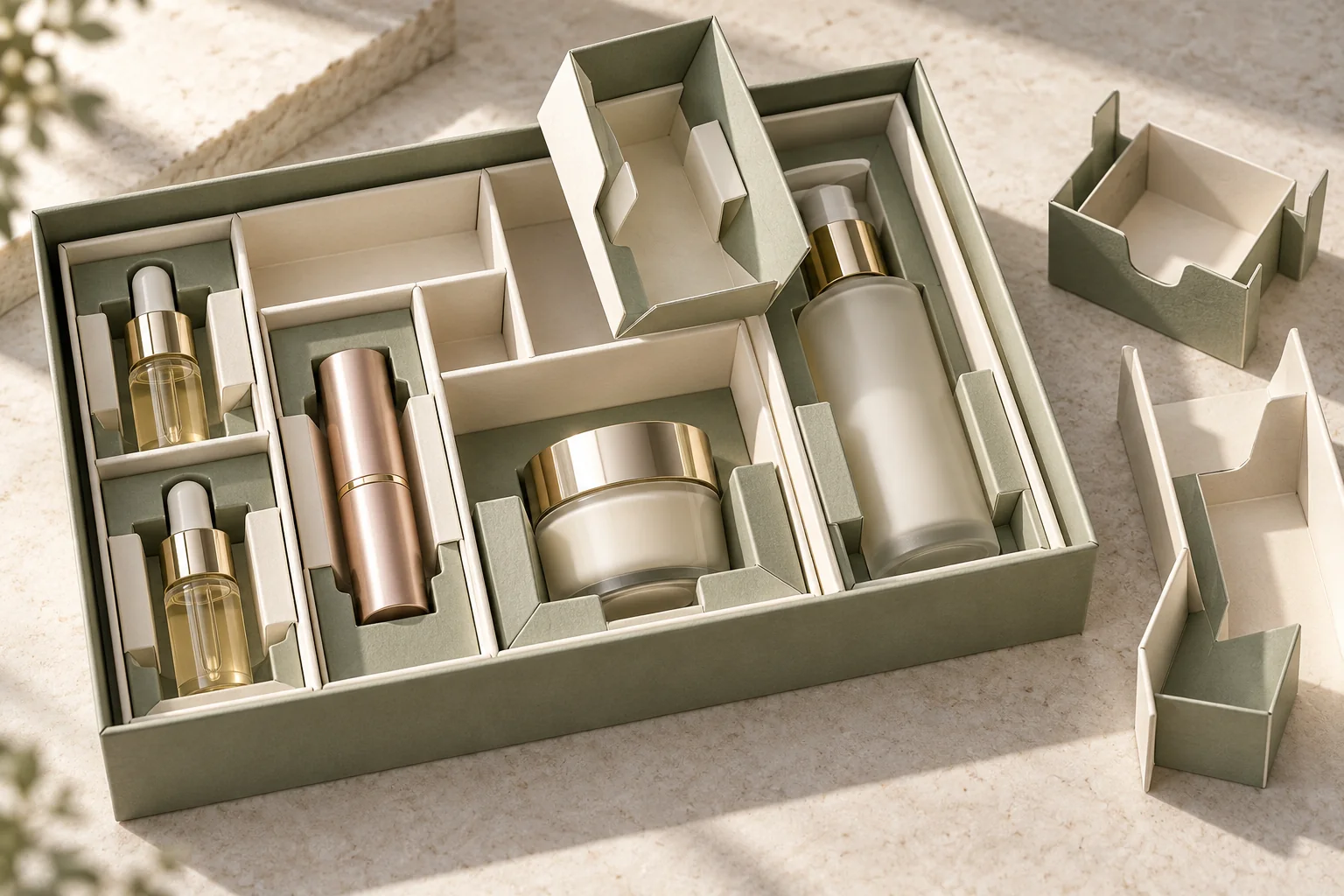
- Keep glass bottles from knocking into neighboring items or rigid box edges.
- Check whether droppers, pumps and caps need clearance or secondary retention.
- Make each item easy to grasp; a secure cavity should not require damaging force to remove it.
- Use partitions to separate products that may rub, leak or transfer fragrance.
- Confirm the insert stays seated after the box is opened, turned and packed for shipment.
Folded paperboard dividers can organize cavities, while separate cartons or more rigid drawer constructions may be considered where the product mix or desired presentation calls for them. No insert material is automatically right for every beauty set. Validate retention, product compatibility, loading time and the complete package before production. For fragrance-specific dimensions and presentation considerations, review the company’s perfume box packaging page.
5. Balance decoration, information and material choices
The calendar is a large brand canvas, but decoration should not hide the information needed to identify each product. Plan the visual hierarchy for the front, inside panels, drawer faces and any product card. Keep the day numbers readable in the intended lighting and make the opening direction clear. A printed ingredient or usage card can carry details that would otherwise crowd a small compartment.
Finishes such as foil, embossing, textured paper or selective coatings may support a premium look, but each addition affects the specification and should be reviewed with the supplier. Mintel’s 2026 overview of beauty packaging discusses the market’s focus on functionality, visual differentiation and sustainability—and notes that packaging expectations and recycling conditions vary across markets. See Mintel’s beauty packaging analysis.
For a more considered cosmetic gift box packaging brief, list all components: outer box, drawers or doors, inserts, magnets, ribbons, coatings, labels and protective shipper. Do not claim a calendar is recyclable simply because its visible parts look like paper. Ask for the material specification and confirm how the complete construction is handled in the destination market. Our guide to sustainable luxury packaging covers whole-package design questions in more detail.
6. Sample the actual product set and review shipping
Approve the complete assembly with the real products or dimensionally accurate production packs. Check every compartment, every opening and the finished closed box. Take photos of the loaded calendar before it is moved, then inspect whether products shift, drawers bind, doors tear or the closure presses against a product.
For delivery, test the calendar inside the shipping configuration that will actually be used. A premium Advent calendar may need a separate shipper; the decorative presentation box is not necessarily designed to travel alone. The right distribution test depends on package dimensions, weight, contents and route. Consult the ISTA test-procedure directory and ask a qualified packaging lab which current procedure is appropriate. Do not describe a package as ISTA-certified unless the specific test and certification status have been verified.
After sampling or testing, check product breakage, leaks, scuffing, insert movement, crushed corners, drawer or door function and the outer shipper. If anything fails, adjust one variable at a time—such as clearance, divider shape, board construction or shipper fit—and review a revised sample.
7. Work backward from the holiday launch date
In October 2026, retail coverage already describes beauty calendars that are available to shop or have begun launching. That timing is a useful signal for planning: brands commissioning a fully custom seasonal box should work backward from their next confirmed retail delivery date. It does not establish a universal production lead time. Artwork readiness, product changes, sample rounds, order quantity, freight and retailer intake rules can all change the schedule. Check the current calendar examples in Vogue’s 2026 roundup, then confirm milestones directly with your supplier.
Before asking for a quote, separate the sample and approval stages from the production order. Decide who owns the final product list, who signs off artwork and color, how many physical sample rounds are needed, and when the packed calendar must arrive at the fulfillment site. For more purchasing context, see our guides to gift box MOQ and custom gift box cost.
Supplier brief: what to provide
A clear brief helps a packaging partner assess structure and cost without guessing:
- 12-, 24-day or other confirmed product count, plus a complete SKU and dimension list
- Product photos, packed weights, fragile features and orientation requirements
- Target box footprint, retail display needs and the final shipping configuration
- Desired opening style, number placement, artwork files and finish references
- Target quantity, delivery destination, launch date and sample-approval milestones
- Material preferences, market requirements and any documented environmental claim
- Who will fill the calendar and what the packing sequence needs to look like
How Leo Paper Box can support the project
Leo Paper Box’s cosmetic packaging work can be scoped around your product dimensions, presentation priorities, insert requirements, order quantity and delivery plan. The article’s images are original design concepts, not photographs of a completed customer project; request a sample review to confirm which structure can work for your assortment.
Review our custom packaging capabilities and factory and quality process, then share the product map, launch date and target quantity through the quote request page. The right starting point is a conversation about the contents and pack-out—not a promise that one box format fits every calendar.
References and further reading
- Vogue, “It’s Time! The Best Beauty Advent Calendars of 2026 Have Started Hitting Shelves” (September 16, 2026) — a current retail roundup with examples of product counts, assortments and box formats.
- Progress Packaging, “How to Specify Custom Advent Calendars” — a supplier guide to door, book and drawer formats, dividers and production specification.
- Mintel, “The Future of Beauty Packaging: Here’s What This Means for Your Brand” (updated February 16, 2026) — market context on beauty packaging functionality, differentiation and material expectations.
- International Safe Transit Association (ISTA), Test Procedures — reference directory for selecting a package testing procedure by distribution system.
Note: This guide is general packaging education, not a transport-performance guarantee, certification, regulatory opinion or production quote. Confirm current product dimensions, supplier capabilities, market requirements and test scope before placing an order.